 SolarInfo
Research and procurement note, reviewed July 29, 2026: This article distinguishes telecom network equipment, site infrastructure, energy systems and semiconductor manufacturing. Regulatory eligibility depends on the country, customer, product and end use. An unlisted supplier is not automatically approved, and no manufacturer mentioned here should be treated as a way around sanctions or procurement rules.
China has thousands of manufacturers serving communications, electronics, power and infrastructure markets. So after a buyer learns that Huawei equipment is restricted in some Western networks, or that SMIC is subject to U.S. export controls, the next question is predictable: are there smaller Chinese alternatives?
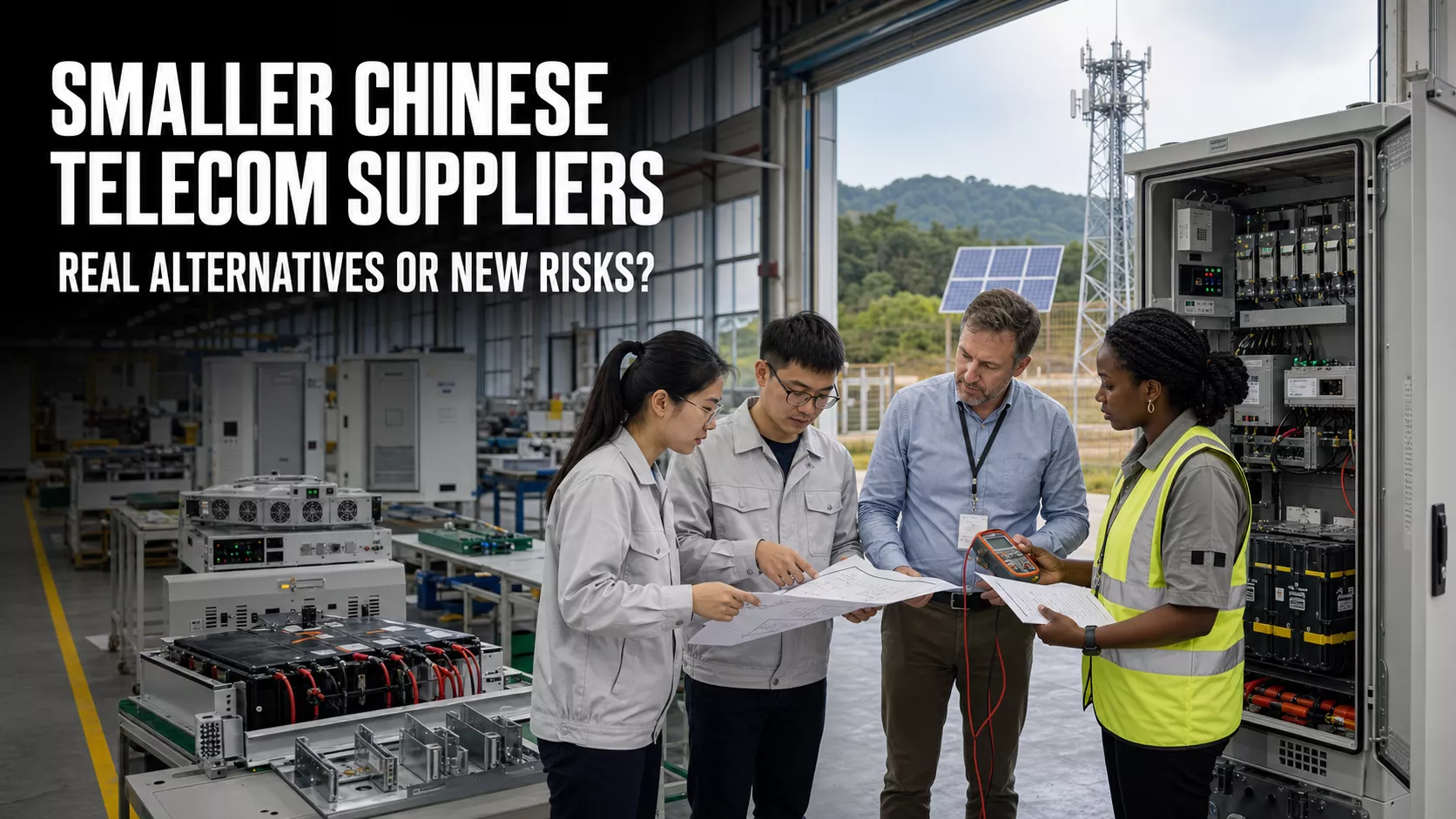
Yes, but the useful answer depends on what needs replacing. China has capable specialist manufacturers of telecom power systems, outdoor cabinets, batteries, inverters, passive infrastructure, antennas, cables and industrial networking products. Some also supply private wireless and edge-network equipment. That does not mean a small company can replace a nationwide 5G core, a mature radio ecosystem or an advanced semiconductor foundry.
The first purchasing mistake is to treat "alternative" as one thing. A lower-cost supplier, a technically compatible supplier, a legally permitted supplier and a trusted long-term supplier are four different tests.
What Kind of Alternative Does the Buyer Need?
| Type of alternative | Question it answers | Why it can fail |
|---|---|---|
| Price alternative | Can another supplier provide similar hardware at a lower cost? | The offer may exclude software, certification, spares or field support |
| Functional alternative | Can it perform the required electrical or network function? | Interfaces, management tools and failure behaviour may differ |
| Regulatory alternative | Is the exact entity and product permitted for this customer and market? | Rules may apply by product category, ownership, origin or end use |
| Security alternative | Can the customer independently control access, updates and data? | A small vendor can have weak security processes or undocumented cloud dependencies |
| Lifecycle alternative | Can it support the deployment for the required operating life? | Financial capacity, patching, replacement parts and engineering continuity may be limited |
A supplier may pass two columns and fail the other three. For example, a compact private-network radio may be technically capable and attractively priced but unacceptable under a government customer's country-risk policy. A battery cabinet may be legally eligible and simple to isolate, yet still fail because the proposed model lacks the required safety documents.
Where Chinese Small and Mid-Sized Manufacturers Can Be Real Alternatives
The closer a product sits to subscriber traffic, encryption keys and network-wide control, the harder it is to substitute safely. Products with standard physical interfaces and limited data access are usually easier to qualify.
| Product layer | Potential for specialist Chinese suppliers | Main buyer concern |
|---|---|---|
| Passive structures, mounts, cable trays and enclosures | High | Materials, structural calculation, corrosion protection and dimensional control |
| Solar, batteries, rectifiers, inverters and hybrid site power | High when interfaces and remote access are controlled | Electrical safety, usable energy, firmware, alarms, local operation and support |
| Cooling, environmental sensors and tower lighting | Moderate to high | Reliability, environmental rating, alarm integration and certification |
| Antennas, filters and passive RF components | Moderate to high | Measured RF performance, intermodulation, traceability and operator approval |
| Microwave, routers and private wireless access equipment | Moderate | Software assurance, spectrum approval, management access and long-term patches |
| Public 4G/5G radio access networks | Limited and project-specific | Interoperability, scale, patent licensing, software maturity and national vendor policy |
| Mobile core and public-safety communications platforms | Low without extensive independent assurance | Keys, traffic, lawful access, privileged control, uptime and regulatory approval |
| Advanced semiconductor foundry services | Not a simple small-company substitution | Process node, design libraries, yield, capacity, equipment controls and requalification |
Passive infrastructure is the easiest place to broaden the supplier base
Tower steelwork, equipment frames, outdoor enclosures and cable-management products do not normally process network data. The risk is physical rather than informational. A buyer can inspect welds, coatings, dimensions, ingress protection and materials against drawings and test requirements.
That does not make the category effortless. A cabinet advertised as IP55 may have been tested only in a configuration different from the one being quoted. A coastal tower needs a different coating system from a dry inland site. Certification must match the supplied model, while factory inspection must examine the actual production process.
Telecom energy is a practical specialist-manufacturer market
A remote site may need photovoltaic generation, LiFePO4 storage, a -48 V DC plant, an inverter for auxiliary loads, generator control, surge protection and remote alarms. These functions are demanding, but their electrical boundaries can be documented. The power system can normally be segmented from subscriber and core-network traffic.
This is where a focused supplier can compete with a large telecom group. A regional operator ordering 200 hybrid cabinets may need a specific generator interface, a different battery-heating strategy and an alarm map that fits its existing NOC. A smaller engineering organization can sometimes make those changes faster than a broad multinational platform vendor.
Huijue Group's solar telecom power systems and services focus on this energy layer: photovoltaic generation, LiFePO4 storage, hybrid power control, inverters, rectifiers, outdoor cabinets and remote energy management for cellular towers, repeaters and microwave sites. That narrower scope makes the trust boundary easier to define than it would be for a mobile core. It does not remove the need to review firmware, remote access, certifications and after-sales support.
Private wireless and edge equipment need a stricter test
China also has smaller suppliers of private LTE or 5G systems, industrial routers, gateways and wireless bridges. They may fit factories, mines, ports, farms or temporary networks where the owner controls the spectrum and architecture. The commercial attraction is clear: compact systems, flexible customization and lower entry cost.
The security burden rises quickly. Buyers need to know who maintains the software, where management traffic goes, whether default accounts can be removed, how vulnerabilities are reported and how long patches will be issued. A product demo proves radio operation; it does not prove five years of secure maintenance.
Core networks are not a sensible place to choose by factory price
A mobile core controls authentication, policy, sessions and often sensitive operational data. An unknown supplier may offer a standards-based package, but the operator still needs performance under failure, lawful-access compliance, protocol security, key management, upgrade discipline and around-the-clock support.
For this layer, "smaller than Huawei" is not a positive qualification by itself. A small company may be easier to work with, but it can also have fewer security engineers, less test coverage and a higher key-person risk. Public and critical networks should use vendors accepted under the relevant national framework and tested for the intended scale.
Replacing SMIC is a semiconductor qualification project
China has other foundries and many chip-design companies, especially for mature process nodes, power electronics, analogue devices, microcontrollers and connectivity components. Some can provide alternatives for a specific part. The buyer still cannot replace one foundry name with another on a purchase order and expect the same chip.
A foundry change can require a new physical design, process library, mask set, packaging route, reliability programme and customer qualification. Yield and capacity matter as much as nominal process-node capability. For advanced baseband, artificial-intelligence or networking silicon, the available manufacturing options are narrower and export-control exposure is more complex.
A Smaller Chinese Vendor Is Not Automatically a Regulatory Workaround
Some U.S. restrictions identify named entities and their subsidiaries or affiliates. Other rules can reach equipment categories, foreign-produced components, public funding or specified end uses. The FCC Covered List, export-control lists and government-contract clauses do not perform the same function.
The European approach also considers non-technical supplier factors. The EU ICT Supply Chain Security Toolbox published in 2026 addresses dependencies on high-risk suppliers and broader supply-chain scenarios. A supplier may therefore face scrutiny because of ownership, legal jurisdiction, access or dependence even when its name is absent from a particular list.
Replacing a restricted brand with an undisclosed original equipment manufacturer is especially risky. White-label products are legitimate when origin, firmware ownership, certification and support responsibilities are disclosed. Rebadging equipment to hide the manufacturer can breach tender terms, customs declarations, authorization rules or sanctions screening.
A credible Chinese manufacturer should be willing to identify its legal entity, factory, component origin and software responsibility. If a sales agent suggests that a different logo will solve a legal problem, stop the review.
Why Buyers Still Consider Chinese Specialist Manufacturers
Security policy has not erased the commercial reasons operators source from China. The manufacturing ecosystem is deep, engineering lead times can be short, and suppliers often accept customization that a large standardized vendor rejects.
- Direct access to engineering: the customer may speak with the people responsible for electrical, mechanical and firmware decisions rather than only a regional sales office.
- Flexible configuration: cabinet dimensions, battery capacity, DC distribution, alarm points and environmental options can be adjusted for the project.
- Lower minimum order quantities: a specialist may support a pilot or regional rollout before a national volume commitment.
- Factory integration: power, storage, control, cooling and protection can be assembled and tested before shipment.
- Cost discipline: lower overhead and dense local supply chains can reduce price without necessarily reducing performance.
- Standards-based interfaces: some specialists are willing to use open protocols because they do not profit from locking the buyer into a complete telecom stack.
These are potential advantages, not evidence. They should be confirmed through documents, factory audits, sample testing and contract terms.
The Less Obvious Risks of a Smaller Supplier
A polished product sample can hide an immature organization. Before replacing a large vendor, check whether the proposed alternative depends on one firmware developer, one export salesperson or one critical component that is already near end of life.
- Limited support depth: a small team may struggle with simultaneous faults across several countries.
- Weak change control: component substitutions may occur without a formal customer notification process.
- Certification mismatch: a test report may cover a related model, not the ordered configuration.
- Short software commitment: security patches and mobile applications may disappear before the hardware reaches end of life.
- Financial exposure: a long warranty has little value if the supplier cannot fund replacements.
- Documentation gaps: incomplete schematics, alarm lists, settings and English manuals create field risk.
- Hidden third parties: cloud platforms, firmware modules or communication gateways may be controlled by another company.
A larger brand is not immune to these problems. The difference is that a smaller supplier often requires the buyer to verify more of the organization behind the product.
How to Qualify a Chinese Telecom Specialist
1. Verify the company before evaluating the brochure
Confirm the legal name, registration, beneficial ownership, manufacturing address, export entity and relationship between the factory and sales company. Screen names in Chinese and English, including former names, subsidiaries and major shareholders. Ask who owns the design and firmware.
2. Draw the trust boundary
Mark what the equipment can see and control. A battery management system can disconnect power. A site gateway can send data outside the network. A passive cabinet cannot do either unless electronics are added. Risk should follow capability.
3. Match compliance evidence to the exact model
Request declarations, laboratory reports and certificates applicable to the destination and product category. Depending on the system, relevant evidence may include electrical safety, electromagnetic compatibility, radio approval, battery transport testing, stationary-battery safety, PV module qualification, grid-interconnection requirements and enclosure protection. Do not accept a folder of unrelated certificates as proof.
4. Review software as part of the product
Ask for a software bill of materials, supported-version policy, signed-update method, vulnerability-reporting contact and patch-response targets. Capture network traffic from the sample during startup, normal operation, remote support and update. Confirm the system still performs its local function when external communications are blocked.
5. Audit production and change control
A useful factory audit follows one serial number from incoming material through assembly, test and shipment. Review calibration, non-conformance handling, firmware loading, battery-cell traceability and engineering-change approval. Ask how customers are notified when a controller, cell, relay or communications module changes.
6. Run a pilot that includes failure
Do not limit the pilot to a sunny demonstration. Disconnect the grid, interrupt the cloud connection, force a high-temperature alarm, simulate a failed battery module and verify restoration after deep discharge. For network equipment, include malformed traffic, upgrade rollback, credential revocation and link failure.
7. Make support measurable
Specify spare-parts location, response time, escalation contacts, remote-access approval, technician competence and replacement procedure. For an overseas rollout, ask who crosses the border when remote support is not enough.
A Practical 100-Point Supplier Scorecard
| Assessment area | Weight | Minimum evidence |
|---|---|---|
| Regulatory and customer eligibility | 20 | Entity screening, product classification, destination and end-use review |
| Technical fit and interface control | 20 | Approved specification, drawings, protocol list and failure behaviour |
| Cybersecurity and software transparency | 20 | SBOM, signed updates, access matrix, patch policy and traffic test |
| Lifecycle service and spare parts | 15 | Support plan, regional spares, escalation route and end-of-support notice |
| Manufacturing quality and traceability | 10 | Factory audit, serial records, test reports and change control |
| Commercial and contractual strength | 10 | Warranty funding, liability, insurance, delivery terms and exit assistance |
| Environmental and social due diligence | 5 | Material origin, labour controls, recycling route and required declarations |
A total score should not override a veto. A legally prohibited product, concealed remote connection, false certificate or hidden manufacturer is a rejection even if the price and technical demonstration are excellent.
Which Purchases Make Sense?
Chinese specialist suppliers are often credible candidates for telecom site energy, batteries, cabinets, passive infrastructure, cooling and other functions whose interfaces can be measured and isolated. They can also be considered for private wireless or edge equipment when the customer has the skills to test and maintain the system.
They are not automatic replacements for public mobile cores, national-security networks, large-scale RAN ecosystems or advanced semiconductor production. In those categories, regulatory acceptance, software depth, intellectual property, supply-chain continuity and scale can outweigh the hardware price.
The best first question to a smaller manufacturer is not "Are you cheaper than Huawei?" It is this: "Show us exactly what you design, what you outsource, what the product can access, how it fails, and who supports it five years from now." The quality of that answer tells a buyer far more than the company's size.
This article provides general procurement and technology information. It is not legal advice, export-control advice or an approval of any supplier for a specific network.
